

Written by the Tauro Workwear team, ex-tradesmen turned workwear trouser designers
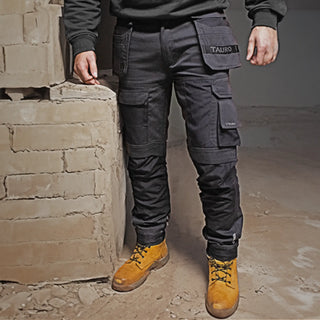
Short answer: slim fit vs regular fit work trousers comes down to how you move and what you wear underneath. Slim fit, with stretch in the fabric, snags less, holds a knee pad steadier and looks tidier in a customer's home. Regular fit gives more room for big thighs and heavy winter layers.
We design slim fit work trousers in Redditch, so you know where we lean. But this is the slim fit vs regular fit work trousers question answered straight, including who should not buy slim. We are a small team of ex-tradesmen, and we have worn plenty of baggy kit that caught on every rung going.
What do slim, regular, loose and skinny actually mean?
There is no British standard for cut, so every brand uses these words a bit differently. In work trousers they roughly mean this:
- Slim fit: follows the line of your thigh and lower leg with room to move. Normal waist and seat. Most slim leg work trousers worth buying put stretch in the fabric so the closer cut still lets you squat.
- Regular fit: straight leg from thigh to hem with extra room throughout. The traditional work trouser shape. Most of the big names sell this as their default.
- Loose fit: generous through the seat, thigh and leg. Room for layers and knee pads that float. Lots of spare fabric.
- Skinny fit: tight from thigh to ankle. Skinny work trousers are rare because there is very little space for a knee pad, a base layer or a deep squat.
Mens slim fit work trousers sit in the middle of that range: closer than regular, nowhere near skinny.
Slim fit vs regular fit work trousers: the comparison table
| Cut | Snag risk | Mobility | Knee pad stability | Room for layering | Look |
|---|---|---|---|---|---|
| Slim | Low | High with stretch fabric, poor without | Good, pad held close to the knee | Thin base layer | Tidy, modern |
| Regular | Medium | Good, room to move even in rigid fabric | Fair, pad can shift | Good | Traditional |
| Loose | High | Good, but extra fabric drags | Poor, pad swings | Very good | Baggy |
| Skinny | Very low | Restricted for kneeling and squatting | Poor, little room for a pad | Very little | Fashion led |
This is our view from wearing all four on site, not a lab test. Fabric matters as much as cut, which is the next point.
Is slim fit safer on site?
Loose fabric catches. Anyone who has climbed a ladder in baggy trousers knows the feeling of the hem hooking a rung. On a roof, a wide leg snags on ridge tiles and the edge of battens. Up in a loft, it catches on joists, nails sticking through the sarking and the corner of the hatch. Round machinery, a mixer, a disc cutter or a pillar drill, loose fabric is a genuine hazard rather than an annoyance.
A slim leg has less spare material to catch on anything. It does not make you safe on its own, and it is no substitute for proper PPE or a risk assessment, but it takes one daft hazard out of the day. We go into this more in why fit matters and the problem with baggy workwear.
Why does slim fit need stretch?
This is where a lot of slim trousers go wrong. Cut a trouser close and make it in rigid polycotton and you get a trouser that binds when you kneel on a screed, pulls tight across the seat when you squat to a consumer unit, and rips at the crotch the first time you step up onto a trestle. Rigid slim is bad workwear.
The fix is elastane in the fabric itself, not just a stretch gusset. Our Rampage and Outlaw are 60% cotton, 38% polyester, 2% elastane. The Ranger is 98% cotton, 2% elastane. That 2% is what lets a slim cut move like a regular one. If you are looking at slim trousers from any brand, check the label for elastane before anything else.
Where does the knee pad sit in slim vs regular fit?
In a loose or regular trouser, the knee pad pocket hangs away from the knee. When you kneel, the pad can swing to the side or slide down your shin, and you end up kneeling on the edge of it. A slimmer leg holds the pocket closer to the knee, so the pad stays where you put it.
Two caveats. First, leg length has to be right, because a pocket at the wrong height is wrong in any cut. Second, certification. Tauro knee pad pockets take standard inserts but are not EN 14404 certified. If you kneel most of the day, tiling or laying floors, or your site demands certified knee protection, buy an EN 14404 certified trouser and pad system. Most of those are regular cuts.
Does the look matter in customers' homes?
More than people admit. If you are doing second fix in someone's kitchen, a bathroom refit or a callout, you are in their house all day. Baggy, flapping trousers with half the site still on the hems look scruffy. A slim black trouser looks tidy, reads as someone who takes the job seriously, and takes up less room when you are working in a cupboard under the stairs.
Removable holsters help too. Take them off for the customer walk-round, put them back on when you are fixing.
Who should not buy slim fit work trousers?
Slim is not for everyone, and we would rather say so than take a return:
- Very muscular thighs. If you train legs hard or have a big build through the thigh, a slim cut may sit too close even with stretch. A regular cut will be more comfortable.
- Heavy winter layering. If you wear thick thermals or fleece-lined bottoms under your trousers through January, regular or loose gives you the room. Slim takes a thin base layer, not a full second pair of trousers.
- Certified knee system needed. If your work or your site needs EN 14404 certified knee protection, our pockets will not meet it. Buy a certified system.
For more on the trade-offs, read does it matter if your workwear is loose or tight.
How do you size slim fit work trousers?
- Measure your waist where your work trousers sit, which is usually a bit lower than your jeans.
- If you are between sizes, or you are coming from baggy workwear, size up on the waist. Our trousers are cut slim, not small.
- Check leg length. Tauro trousers come in 30" to 40" waist with a 32" regular leg only. If you need a short or long leg, we are not the right fit yet.
- Do a squat and a kneel when they arrive, with a knee pad in. The seat should not pull tight, and the pad should sit on the knee.
Full measurements are on our size guide.
Our verdict on slim fit vs regular fit
For most tradesmen who climb, kneel on and off and work in customers' homes, slim fit with stretch fabric is the better choice: less snagging, a steadier knee pad and a tidier look. Regular fit still wins for big thighs, heavy layering and certified knee systems. If slim sounds like you, have a look at our slim fit work trousers. The Rampage, with removable holster pockets, is our best seller and the place most people start.
Try slim fit for 30 days
If you have never worn a slim work trouser, the only way to know is to wear one on site. Delivery is free across the UK on Royal Mail Tracked 48, and returns are free within 30 days. If slim is not for you, send them back.
Frequently asked questions
Are slim fit work trousers practical?
Yes, as long as the fabric has stretch. A slim cut with elastane in the fabric moves with you when you kneel, squat and climb, and there is less loose material to catch on ladders, scaffold and joists. A slim cut in rigid fabric is not practical: it binds at the knee and pulls at the seat.
What is the difference between slim fit and skinny work trousers?
Slim fit follows the shape of your leg with enough room to move and to wear a knee pad. Skinny fit sits tight to the leg all the way down. Skinny cuts look sharp but leave little room for knee pads, thermals or a full squat, which is why most work trousers that call themselves skinny are really a close slim.
Do knee pads work in slim fit work trousers?
They can work better, because a slimmer leg holds the pad closer to the knee and stops it swinging. The pocket height has to match your leg length though. Tauro knee pad pockets take standard inserts but are not EN 14404 certified, so if you need certified knee protection, choose a certified trouser and pad system.
Should I size up in slim fit work trousers?
If you are between sizes, or moving from baggy workwear, size up on the waist. Slim fit trousers are cut slim through the thigh and leg, not small at the waist. Measure your waist where your work trousers actually sit, not where your jeans sit, and check the size guide before you order.
Are regular fit work trousers better for winter?
If you wear thick thermals or fleece-lined base layers under your trousers, a regular fit gives you more room for them. A slim fit with stretch fabric will take a thin base layer comfortably, but it is not designed for heavy layering. Plenty of tradesmen run regular fit in deep winter and slim the rest of the year.
0 comments